DEVCOM Armaments Center push continues to enable industry to develop and deliver lethality via plug-and-play drone payloads
November 6, 2026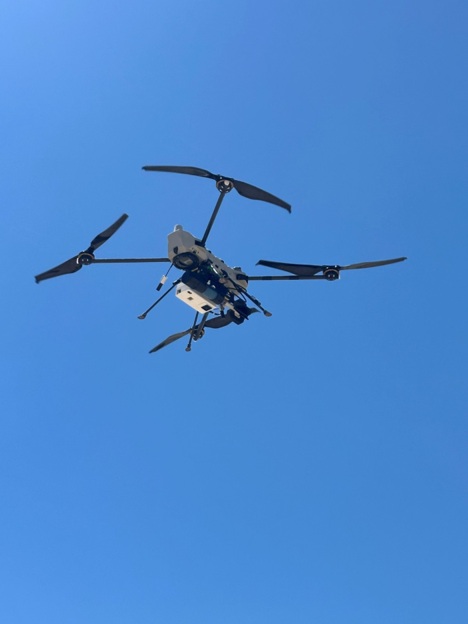
A drone equipped with the Armament Center’s Picatinny Common Lethality Integration Kit (CLIK) hovers overhead at the Project Convergence-Capstone 6 on Monday, July 20.
By Tyler Barth November 5, 2026
PICATINNY ARSENAL, N.J. – Government, industry and technical experts convened here and online on Tuesday, Sept. 15 to confront one of the most urgent challenges in unmanned systems development: bringing true plug‑and‑play lethality to the drone ecosystem.
Hosted by the National Armaments Consortium (NAC) and led by the Project Manager Close Combat Systems (PM CCS) team, the U.S. Army Combat Capabilities Development Command (DEVCOM) Armaments Center, the webinar served as a gateway for more than 500 industry partners to learn what resources are available to pair conventional payloads to drone platforms. Also contributing to making it a success were the Direct Reporting Portfolio Manager for Unmanned Systems (DRPM UxS) team and those at Drone Dominance.
This initiative, called Conventional Munitions for UxS, aims to pair conventional payloads with unmanned systems through modular interfaces. Plug‑and‑play modularity and collaborative development stood front and center as major topics, with much of the discussion focused on using standard interfaces and protocols at the junctures between components, known in industry as the Modular Open Systems Approach (MOSA).
According to PM CCS Col. Isaac Cuthbertson, the webinar was influenced by a clear gap in acquisition landscape, as while the commercial sector leads the way in drone flight controls, battery life and materials, the Army and industry must develop a true partnership to catch up on integrating state-of-the-art drone with state-of-the-art lethal payloads for military missions.
Cuthbertson noted the importance of maintaining common interfaces and protocols so payloads and platforms can evolve modularly without forcing redesigns across the entire system. The intent is to prevent changes in one component, like a sensor, platform or munition, from cascading into unneeded redesigns elsewhere. MOSA supports this by allowing individual parts to be upgraded swiftly while keeping the system’s broader capabilities stable.
He also emphasized the importance of incorporating safety into design early and often. “The traditional approach of bolting safety on at the end of the engineering process simply does not work for the speed at which we are trying to achieve today,” said Cuthbertson.
Cuthbertson showed great confidence that the webinar would close gaps by giving companies technical insights and guidance to integrate lethal payloads swiftly, responsibly and in a modular manner.
The Direct Reporting Portfolio Manager for Unmanned Systems (DRPM UxS) is a newly established office reporting directly to the Deputy Secretary of War. Established in July, the office enforces joint technical standards, interoperability baselines and MOSA requirements.
By shifting away from fragmented and service-specific acquisitions, DRPM UxS rapidly accelerates the development, procurement and fielding of autonomous systems specifically tailored to the operational demands of Geographic Combatant Commands. Notably, this unified approach aggregates joint requirements into a clear and sustained demand signal, giving industry the confidence and scale necessary to rapidly accelerate domestic production.
Experts from the Armaments Center highlighted the various intricacies of drone lethality, covering fuze safety, energetics, the Picatinny Common Lethality Interface Kit (CLIK) and fire control, alongside other topics.
All maintained throughout how accelerating drone lethality requires collaboration, rather than competition, as evidenced by active projects under the Cooperative Research and Development Agreement (CRADA) between the Armaments Center and the NAC member companies. Interfaces such as CLIK follow the MOSA standard, which provides its followers with shared resources and interoperability between platform and payloads.
The NAC is a coalition of leading engineers, designers and technologists which acts as a bridge between parties to advance armaments technologies. Director of Customer Affairs Don Palathinkal encouraged companies to join the NAC and partner with the Army through the NAC-Armaments Center CRADA. This collaboration pathway will help prepare the strongest possible lethal drone designs for production.
PM CCS Chief Systems Engineer Snehali Patel explained that questions mostly regarded efforts to homogenize safety review criteria and the timeframe for selecting a standardized interface. Attendees expressed a desire for consistent safety review rules, processes and expectations. Organizers received 72 questions during the open forum.
The webinar painted a picture of how unmanned systems are gradually shifting toward standardized interfaces and the importance of consolidated oversight and early collaboration. Rapid advances, the speakers noted, will come from shared frameworks and partnerships, not isolated development, and for unmanned systems to thrive going forward, plug-and-play will remain at the forefront.